Churchill1 animal documentation
Bone characteristics and body composition of 63 F1-hybrid mouse strains from an 8-way diallel cross (2004)
Churchill GA, Baldwin CCreation of an 8-way F1 cross
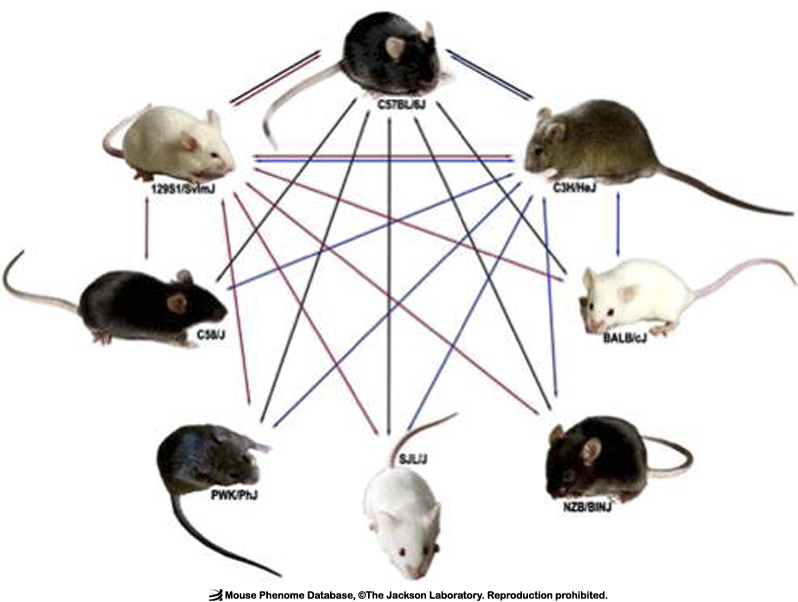
Reciprocal mating between parental inbred strain 129S (red arrow/allele), B6 (black), and C3 (blue) is illustrated, wherein both male and female from one inbred strain are mated to another inbred strain.
Eight inbred strains depicted above are bred reciprocally to each other to generate the following F1 offspring: 129SB6F1, 129SB8F1, 129SC3F1, 129SCF1, 129SNZBF1, 129SPWF1, 129SSJLF1, B6129SF1, B6B8F1, B6C3F1, B6CF1, B6NZBF1, B6PWF1, B6SJLF1, C3129SF1, C3B6F1, C3B8F1, C3CF1, C3NZBF1, C3PWF1, C3SJLF1, B8129SF1, B8B6F1, B8C3F1, B8CF1, B8NZBF1, B8PWF1, B8SJLF1, C129SF1, CB6F1, CB8F1, CC3F1, CNZBF1, CSJLF1, NZB129SF1, NZBB6F1, NZBB8F1, NZBC3F1, NZBCF1, NZBPWF1, NZBSJLF1, PW129SF1, PWB6F1, PWB8F1, PWC3F1, PWCF1, PWNZBF1, PWSJLF1, SJL129SF1, SJLB6F1, SJLB8F1, SJLC3F1, SJLCF1, SJLNZBF1, SJLPWF1.
Mice were housed in JAX® production or research rooms until either 7-8 weeks of age when sample collection took place. The F1 mice are acclimated in the research laboratory mouse room and aged until 8-wk of age before testing. BALB/cJ inbred strain crossed to PWK/PhJ wild inbred strain is the only breeding that did not yield (CPWF1) litters. Mice were 10-13 wks of age on the day of sacrifice All strains maintained on a sterilized 6% fat diet (NIH316 formula, Purina item #5K52 from age of weaning Adjusted with hydrochloric acid to pH 2.8-3.1 and supplemented with menadione sodium bisulfite (final concentration 0.4 mg/ml) to compensate for potential decrease in vitamin K activity upon autoclaving; water supplied in pinhole type bottles (Thoren Caging Systems, Inc. Hazelton, PA). Thoren cages; Thoren Maxi Miser #3 cages used for some strains as either part of a PIV (pressurized individually ventilated) system or placed on conventional racking. 18 - 24°C Steam autoclaved white pine shavings ~50%. 14 hrs on (generally covering the hrs of 4:30 AM to 6:30 PM) 10 hrs off The Jackson Laboratory Diagnostics Laboratory routinely monitors and documents animal health status using statistically valid sampling procedures and standard protocols. (Sentinel animals are tested). Detailed health status reports for each animal room represented from this project are on file and available on request.
Note: CPWF1 is the only breeding that did not yield litters.