Pletcher1 project protocol
Open field and tail suspension tests in males of 32 inbred strains of mice (2007)
Pletcher MTWith: Miller BH, Schultz LE, Gulati A, Su AI
Project protocol — Contents
Workflow and sampling
Equipment
Reagents, supplies, and solutions
Procedure 1: Conducting behavioral tests
Procedure 2: Corticosterone radioimmunoassay
Data
References
Workflow and samplingWorkflow
Procedure performed
Data collected
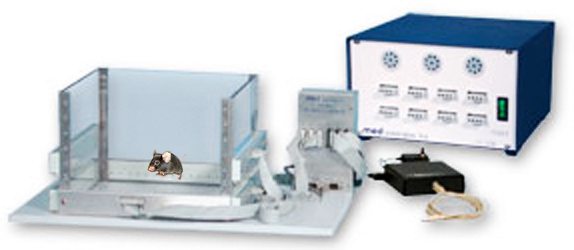
• Mouse Tail Suspension setup (Med Associates, Georgia, VT) see Figure 1 below
• Open field arena: Med Associates mouse Open Field contained within an environmental chamber that provides white noise and low, indirect lighting. This package includes a 10.75" x 10.75" (27.3 cm x 27.3 cm) test environment with three 16 beam infrared (I/R) arrays, 48 channel control, cables, interface card, power supply, and single station software. Up to eight test stations may be attached to a single computer. These boxes measure activity using infrared beam breaks on the x, y, and z axes (see Figure 2 below).
• Computer
• Freezer at -80°C
• Dissecting kit: decapitatorFigure 1. Schematic layout of the tail suspension test (not drawn to scale).
Figure 2. Schematic layout of the open field arena.
• Double antibody RIA kit for serum corticosterone (Diagnostics Products Corp. Los Angeles, CA)
• Ice and ice bucket
• Disinfectant solution
• Paper towels and other cleaning materials
• Blood collection tubesProcedure 1: Conducting behavioral tests
Common procedures
a. Mice are brought from separate colony rooms to the testing room before behavioral survey is done.
b. Behavioral testing is conducted between 1300h and 1600h.
c. Strains are randomized across day, time of testing, and equipment.
d. Four to eight mice are tested at a time, and each individual is only tested once in each task.
e. The behavioral apparatus is cleaned with a disinfectant between each test, and at the end of each survey, mice are returned to their home cages.
Tail suspension test
a. Tail Suspension Test (TST) is performed using a Med Associates Mouse setup.
b. In this test, the mouse is placed inside a 3-sided cubicle and suspended by its tail from a hanger attached to a precision linear load cell that measures activity.
c. Mice are acclimated to testing conditions for at least 1 min, this is to account for the fact that mice are uniformly active during this time.
d. Measurements are taken in 200-ms increments for 7 min, with threshold = 3 and gain = 8.
e. Percent immobility is calculated by determining the time spent immobile during the last 6 min of the test, and reported as percent of time (on a scale of 0-1) spent immobile during the TST.
f. Mice that climbed their tail or fell off the hanger are excluded from analysis.
g. Body weights are obtained immediately after the TST, at approximately 7-10 wks of age.
Open field test
a. One week after tail suspension test, mice are tested in a Med Associates mouse Open Field Test (OFT) contained within an environmental chamber that provides white noise and low, indirect lighting.
b. Mice are placed in the center of the field and allowed to explore freely for 10 min.
c. Center time is calculated as the percent of time (on a scale of 0-1) spent in the center 25% of the open field arena.
d. Activity is measured by total distance traveled during the 10 min OFT.Procedure 2: Corticosterone Radioimmunoassay
a. All collections are performed between 1100h and 1500h.
b. Trunk blood is collected within 30 s of removing the mice from the colony room and following immediate decapitation.
c. Blood is allowed to clot on ice, and then serum is separated out and stored at -80°C.
d. Corticosterone is measured from 10 mL of serum using a double antibody RIA kit.
e. The assay is calibrated to within a minimum detectable level of 0.5 mg/dL of serum corticosterone, and interassay/intrassay coefficients of variance of 12.48% and 6.11%, respectively.
f. The RIA is performed by the Ligand Assay Core at Northwestern University.
Data collected and submitted by investigator
Open field test: percent center occupancy and total activity.
Tail suspension test: percent immobility.Serum corticosterone
References
Miller BH, Schultz LE, Gulati A, Cameron MD, Pletcher MT. Genetic regulation of behavioral and neuronal responses to fluoxetine. Neuropsychopharmacology. 2008 May;33(6):1312-22. Epub 2007 Jul 4.
PubMed 17609676